


What Would Ted Do? is my weekly, bite-sized breakdown of Ted Lasso episodes through a leadership lens: practical lessons on trust, culture, conflict, and resilience you can take into your week.

The episode is called “4-5-1.” It’s a tactical formation. But the real formation being tested is inside every person at AFC Richmond.
Zava arrives. The superstar, the legend, the myth in boots. And from the moment he walks through the door, the episode stops being about him. It’s about everyone else.
This is what high-performance disruption actually looks like. A mirror, held up quietly, showing every person in the room exactly who they are when the centre of gravity shifts.
He’s late to his own welcome party. Not fashionably late. Gone-silent, the-hosts-are-nervous late. And then they find him, waiting serenely in Rebecca’s office, completely unbothered, already charming everyone in two sentences.
The first thing you notice is that Zava doesn’t perform dominance (ok, maybe a little). Mostly, he performs ease.
Stars who last earn rooms before they earn records. And the way they walk in tells you everything.
Zava doesn’t swagger. He doesn’t fill the room with noise. He simply has the room’s attention, effortlessly. Genuine confidence doesn’t need the space to know it’s there. It just is.
When Zava finally walks into the locker room, the team goes quiet. Not because he told them to. Because he didn’t have to.
He announces he wants to address the most important person in the room first.
The team waits. He turns… and looks at Jamie.
Then he recalibrates. He’s looking for the kit man.
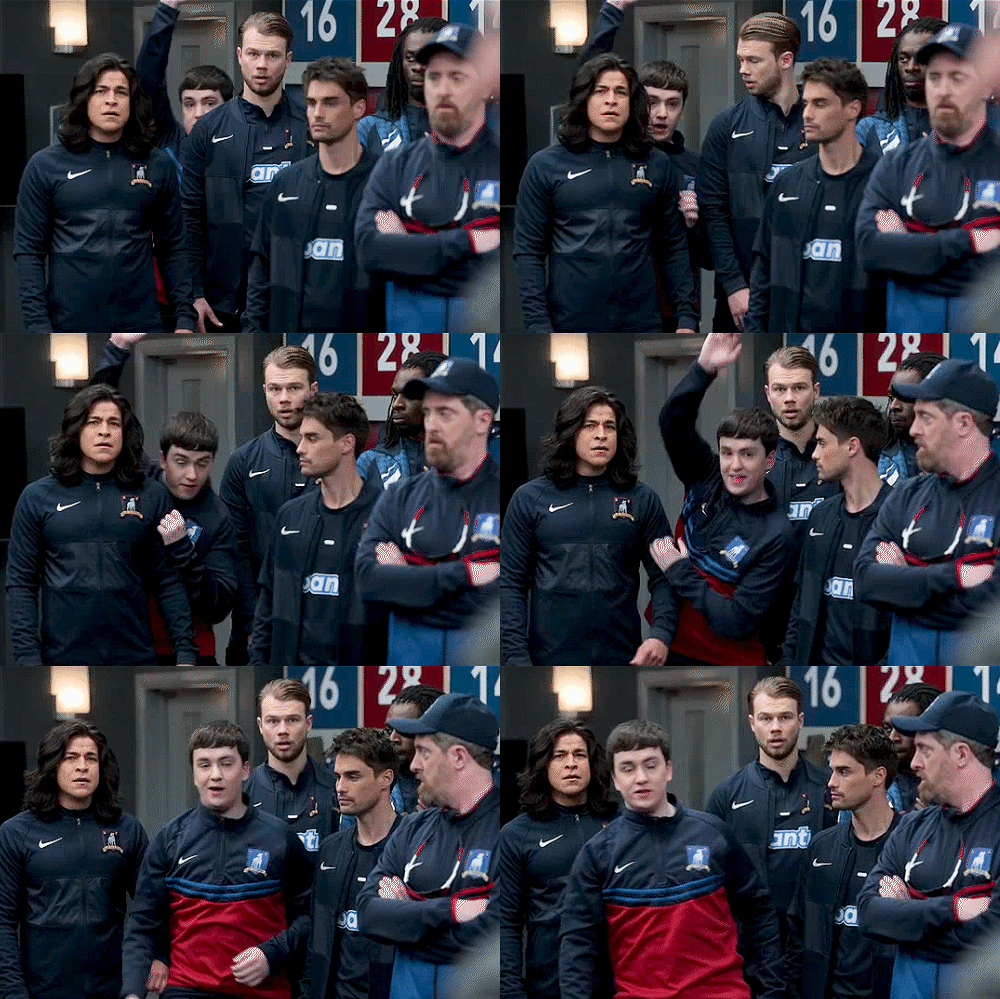
He finds Will. And he speaks to him directly, warmly, about passion and service and why players play at all. “Your passion is why I play.” The whole room watches. Jamie’s face is a masterclass in contained bafflement.
The leaders who endure know that the people who make things run are rarely the people who get thanked for it.
This isn’t a performance for the locker room’s benefit. Zava is doing something he clearly just does. He honours the foundation. The kit man who folds the jerseys, fills the water bottles, keeps the engine quiet so everyone else can be loud. Those people are invisible until someone makes them visible.
In every organisation, there are Wills. People who never ask for credit because the job doesn’t come with it. The leaders who build cultures worth staying in are the ones who find those people and name them.
Jamie corners the coaching staff: Zava is a self-absorbed glory hunter who only cares about himself.
The coaches hear him out. Then Coach Beard points out the obvious: it’s a little ironic, isn’t it? Given who’s saying it.
Jamie stops on his way out the door.
“I wasn’t being ironic. I was hypocritical”
And he leaves.
Knowing you’re hypocritical is further along than most people ever get.
There’s a version of that scene where Jamie doesn’t hear it. But he does pause. He finds the word for what he is, says it clearly, and owns it on the way out.
That’s not the old Jamie. The old Jamie would have doubled down. The old Jamie didn’t have a word for what he was, let alone the self-possession to use it out loud.
He’s still not solving anything. He’s still threatened. He still isn’t thrilled having Zava on the team. But the self-awareness is there. In leadership, that’s the precondition for everything else. You can’t fix what you won’t name.
Just before kickoff, Ted calls home to wish Henry good luck on his own match.
Dr. Jacob answers.
Ted holds it together. He’s professional. He says the right things. He hangs up.
And then he carries it. Through the warmup. Through kickoff. Through Zava’s first goal. Through Richmond climbing the table. Ted is there, doing the job but with a piece of himself somewhere else entirely.
The things we carry at home don’t wait politely at the door.
We talk about leadership as if it’s a mode you switch on. Like the locker room is a clean room, sealed off from everything outside it.
It isn’t. It never is.
Ted has built his whole identity around being the steady one. The one who shows up. The one who smiles when it costs him to smile. And he does it here too. Nobody on the pitch would know. But the cost is there, written just beneath the surface.
Carrying something hard while still doing the job is its own kind of leadership. The kind that leaves no room for performance because you’re spending everything you have just on function.
At the opening of Sam’s restaurant, Roy notices something before Jamie says a word.
Jamie is brooding. Standing apart. Quiet in a way Roy recognises.
So Roy asks. And Jamie tells him the truth: he wants to be better than Zava. Not equal to. Better. Roy doesn’t laugh. Doesn’t tell him to get over himself. He offers to train him.
The best mentors don’t wait to be invited. They notice first, and they show up.
Think about how far Roy Kent has come. A few months ago, the only distance he offered was arm’s length. And here he is now, standing in the warmth of someone else’s restaurant opening, reading the room, finding the one person who hasn’t said he needs help and offering it anyway.
Mentorship that waits to be asked for almost always comes too late. By the time someone raises their hand, they’ve usually been drowning quietly for a while.
Roy didn’t wait. He decided.
That’s the version of leadership that actually changes people - the kind that notices.
On his way out from the restaurant, Trent Crimm rounds a corner.
Colin is kissing his boyfriend. Nobody else is around. Nobody else knows Colin is gay.
Trent doesn’t say anything. He just sees.
Every team is a collection of people carrying things nobody else can see. Sometimes someone catches a glimpse.
Colin is doing his job. Smiling at training. Holding his place in the formation. Being Colin. And inside all of that is something private and heavy and real, that he hasn’t been ready to share.
It’s a reminder- the person next to you in the meeting, on the pitch, in the office may be performing competence while carrying something you don’t know about. Most of the time, you’ll never see it.
So. Zava arrives. Richmond wins. The table moves. Everything is, by the numbers, going exactly right.
And yet.
Jamie is threatened.
Ted is cracked.
Roy is becoming something new.
Colin is carrying something alone.
Will is, for one extraordinary moment, the most important person in the room.
This is the real shape of disruption. The slow revelation of what was already true.
That’s worth remembering the next time something big changes in your organisation. A new hire, a restructure, a key account you just landed. Watch the room carefully for what the change lets you finally see.
I always admire how you manage to distill the essence of every character in each chapter of Ted, almost like Grenouille from Perfume (without the murder, of course!). And there’s always such a lovely takeaway when I finish reading. Thank you so much