


What Would Ted Do? is my weekly, bite-sized breakdown of Ted Lasso episodes through a leadership lens: practical lessons on trust, culture, conflict, and resilience you can take into your week.

This is the episode where things stop working.
Not for Richmond, Richmond is fine. Richmond is winning. Sam is on form, total football is clicking, the results are coming in. Externally, things look better than they have all season.
But for almost everyone else, the scaffolding comes down. Nate’s West Ham experiment collapses. Keeley’s agency funding vanishes. Sam finds out his national team spot was bought away from him. Rebecca walks into a room of powerful men trying to strip football of the thing that makes it worth anything.
The interesting part isn’t the collapse. The interesting part is what gets revealed underneath it.
When Nate loses West Ham, he finds his parents’ house.
When Keeley loses her agency, she finds Mae with a pint.
When Rebecca steps into the super league meeting, she finds something she didn’t know she was going to say.
When Roy finally shows up at Keeley’s door, he finds three words and an admission that was overdue by months.
The episode keeps asking the same question: when the external structures disappear, what’s actually underneath?
The answer, again and again, is the same. The real thing was always there. You just couldn’t see it through all the rest.
Nate quits West Ham.
He doesn’t announce it. He doesn’t make a speech. We don’t even see it happen, we just find out it happened off screen. And then he goes somewhere he hasn’t needed to go in a long time: home.
He doesn’t explain himself to his parents. He just arrives, goes to his old room, and sits with it. His mother doesn’t ask what happened. She doesn’t offer advice. She doesn’t push. She just brings him food. Quietly, steadily, without commentary she brings him a tray. Comes back for it later. Brings another. The montage is a few seconds long and it’s one of the most devastating things in the season. His parents already knew who he was. They were just waiting for him to come back to it.
Unconditional support doesn’t require an explanation. It just keeps showing up.
Nate spent a season building a version of himself he thought would earn respect, fear and belonging. He wore it at West Ham. He performed it for Rupert. And when it stopped working, the thing waiting for him was his mother with a tray. That’s not a small thing. That’s the thing.
There’s a version of this in every team. The person who goes quiet after a failure, who retreats into themselves, who can’t yet say what happened. The instinct is to probe, to check in, to ask questions, to get them to open up.
Sometimes what they need is the tray. Just presence. Without agenda. Without the conversation they’re not ready to have.
Keeley finds out about losing her funding in the worst possible way.
Not from Jack. Not in a call, not with any of the decency the relationship implied. She walks into her own office and Barbara tells her that the VC has pulled out. Just like that. The company Jack funded, the agency Keeley built, the thing that was supposed to be a partnership and the person on the other side didn’t even pick up the phone.
Keeley goes to the bar. Mae pours. Keeley says she has the Midas shits, not the Midas touch. Mae, without skipping a beat: shit is what helps things grow.
How someone delivers bad news tells you everything about how much you actually mattered to them.
Jack managed the situation. She didn’t manage the person. The funding was pulled through proper channels, and the human being at the centre of it found out last. There’s a particular cruelty in that efficiency. Keeley was a portfolio decision. Not a partner.
Mae’s line is funny and also true. Keeley doesn’t need the Midas touch right now. She needs fertiliser. She needs the shitty part that comes before the growing.
Edwin Akufo comes to Ola’s.
He’s charming, as always. And then he tells Sam that he paid the Nigerian government twenty million dollars to keep Sam off the national team.
As punishment for not signing onto hist team.
Because that’s what you do when you have more money than anyone can say no to: you make sure the people who say no anyway learn what that costs.
Money can buy the absence of someone’s name from a list. It cannot buy the fact of who they are.
Sam hears this and has to sit with the knowledge that his merit was never the obstacle.
He was good enough. He is good enough. He was kept out by something that had nothing to do with football.
There’s a particular kind of injustice in that: not the injustice of failure, which you can at least understand and work with, but the injustice of someone reaching into the space where your ability should be enough, and deciding it isn’t, because they have the money to decide that.
Akufo says it like he’s showing Sam the true nature of things. Like wealth makes you honest. What it actually reveals is that the money is the only thing he has that Sam doesn’t.
That’s a smaller advantage than he thinks.
Rebecca is invited to Akufo’s super league meeting by Rupert.
She goes. She sits in the room. She listens to the pitch. A closed league, fixed membership, guaranteed revenue, the biggest clubs in Europe locked into a structure that removes them from the game everyone else plays. Monetised. Controlled. Profitable.
She sits with it for a moment. And then:
“Is this a fucking joke?”
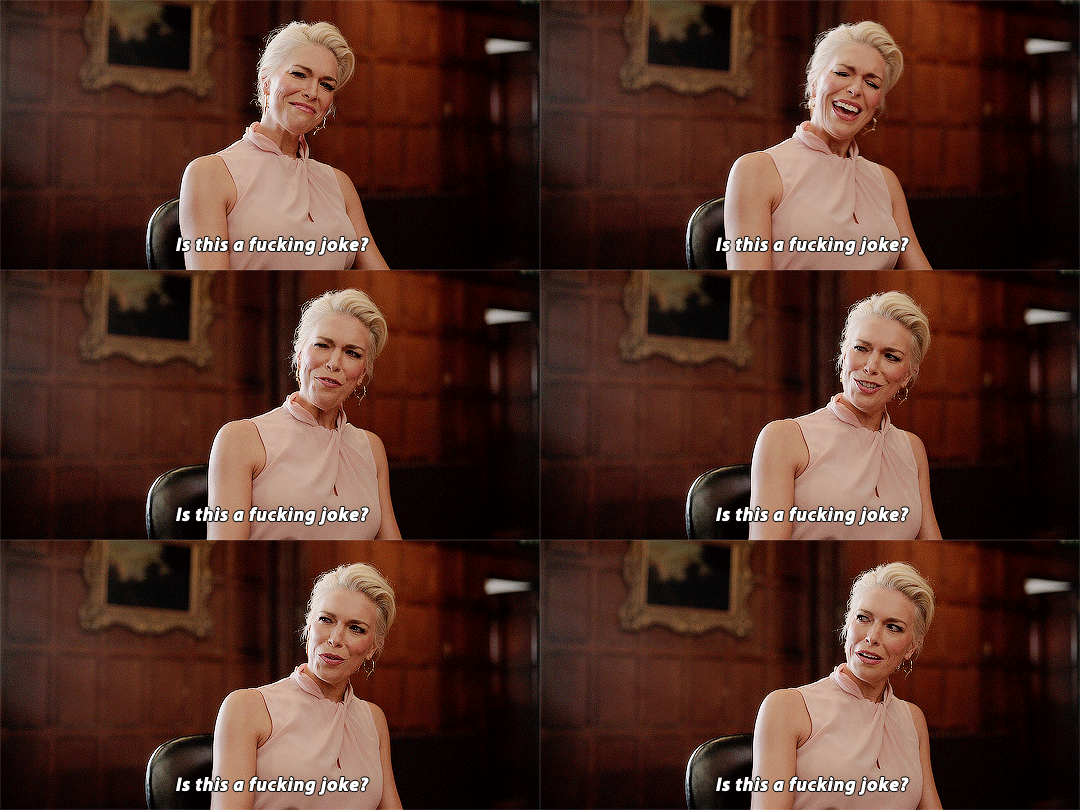
What follows is one of the best speeches in the season. Football isn’t a product. It’s not a revenue stream. It’s the thing that exists for the fans, the ones who grew up with it, the ones who inherited it, the ones who’ve passed it down. Strip that out and you don’t have a better version of football. You have something that looks like football and generates returns.
Integrity in a room full of financial incentives is the most disruptive act available.
Rebecca wasn’t supposed to be in that meeting as a disruptor. She was Rupert’s guest, there to be managed, perhaps to be converted. Instead she says the thing nobody in the room was going to say. Not with power, she’s the smallest club there. With accuracy. That’s all it took.
Nate finds his violin.
He’s been in his old room, in the space his parents have held without fanfare, and he finds it. Something from before all of this, before the coaching career, before West Ham, before the long arc of the last three seasons. Something that was just his.
Then he talks to his dad. His dad says something he’s probably never said before:
“I didn’t know how to parent a genius.”
The things our parents couldn’t give us were often not from indifference. They were from not knowing how.
Nate’s relationship with his father has been an underlying thread running through the show — the approval that never quite came, the distance that was never explained, the sense that Nate grew up in a house where he was loved but not quite understood.
And here his dad hands him something true: not an apology exactly, but an explanation. I didn’t know what you needed, because what you needed was something I didn’t have a map for.
That’s a different kind of wound than cruelty or neglect. It’s the wound of good intentions without the right tools. And it turns out it’s enough to hear it said.
Roy brings Keeley a letter.
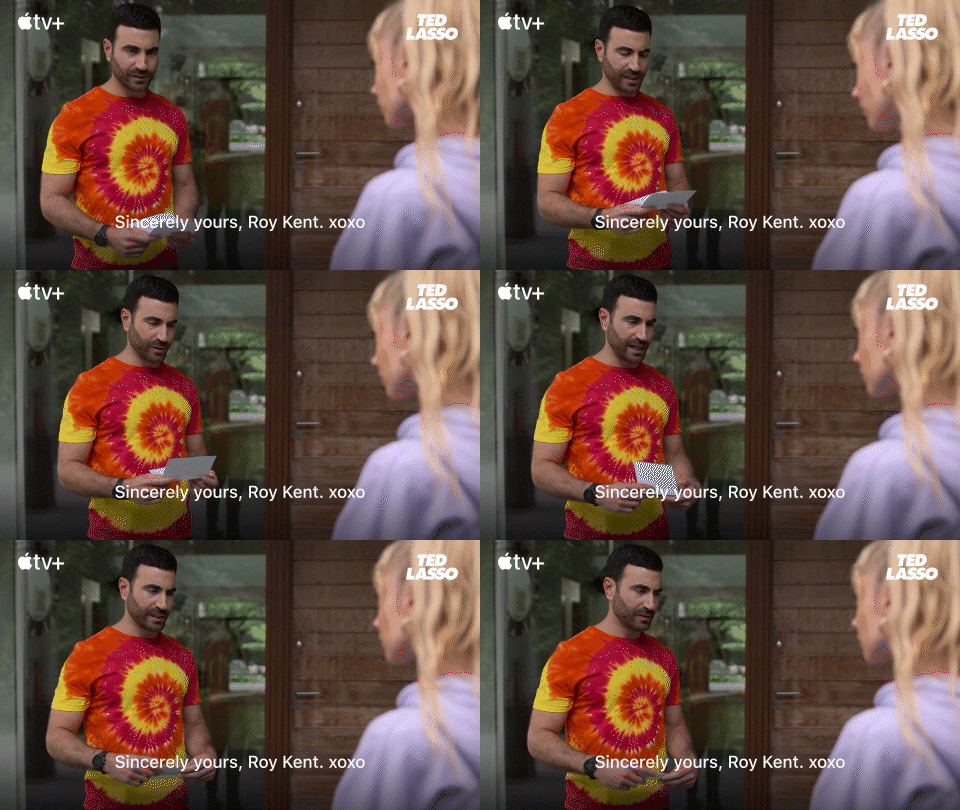
He’s had it for a while. He shows up, which is already something, given how much of this season Roy has spent not showing up for himself. She says she still can’t read his handwriting, which forces him to very awkwardly read the content of the letter in front of her.
And then he says the thing.
“It was all me. I was stuck in my own shit.”
That’s a real apology. Because it doesn’t ask anything back.
No qualification. No “but you also.” No blame-sharing arrangement, no conditional opening. It was me. I was the obstacle. I was the thing that got in the way.
This is what accountability sounds like. Roy strips the whole speech down to its core. That took more than showing up at her door. It took however many months of being stuck to finally get here.
At the end of the episode, Keeley and Rebecca finally catch up.
Everything — the agency, Jack, the funding, the mess — laid out between them. And then Rebecca says she wants to fund the firm.
This is the image the episode (and the season) has been building toward all along. The discovery that the real support structure was already there. It didn’t leave when things got difficult. It was waiting for the conversation to happen.
The network that matters is the one that’s still there after the collapse.
This is what every thread in the episode has been pointing at.
Nate’s parents.
Mae’s shit-and-growth philosophy.
Nate’s dad saying the true thing.
Roy’s letter.
Rebecca’s offer.
When the external structures fall what you’re left with is what was real the whole time. The tray on the bedside table. The friend at the bar. The letter you couldn’t read. The person who was always going to say yes.
What was always there turns out to be what you actually needed. It usually is.
What Would Ted Do? goes out every week. If this landed, share it with someone who’d appreciate it — or just hit subscribe and I’ll see you next episode.*